
Cardiac catheterisation laboratory of the Department of Congenital Heart Desease - Pediatric Cardiology
We examine and treat newborns, infants, children and adolescents of all ages with congenital and acquired heart disease, as well as all adults with congenital heart defects, in two specially equipped, state-of-the-art cardiac catheterisation laboratories at the Department of Congenital Heart Desease - Pediatric Cardiology. As a supra-regional centre of excellence, we specialise in invasive cardiological diagnostics and interventional therapy for patients with congenital heart defects.
Interventional treatments in the cardiac catheterisation laboratory are increasingly supplementing or replacing surgical procedures and are crucial in determining the optimal therapy for patients. Our team has many years of experience and expertise. As the necessary radiation exposure is minimal, examinations in the cardiac catheterisation laboratory are also possible and safe for very young children. In addition, we are constantly developing new procedures that allow us to dispense with the use of X-rays altogether in some cases.
We carry out more than 800 procedures per year in our cardiac catheterisation laboratory. A particular focus is on the examination and treatment of newborns with critical congenital heart defects.
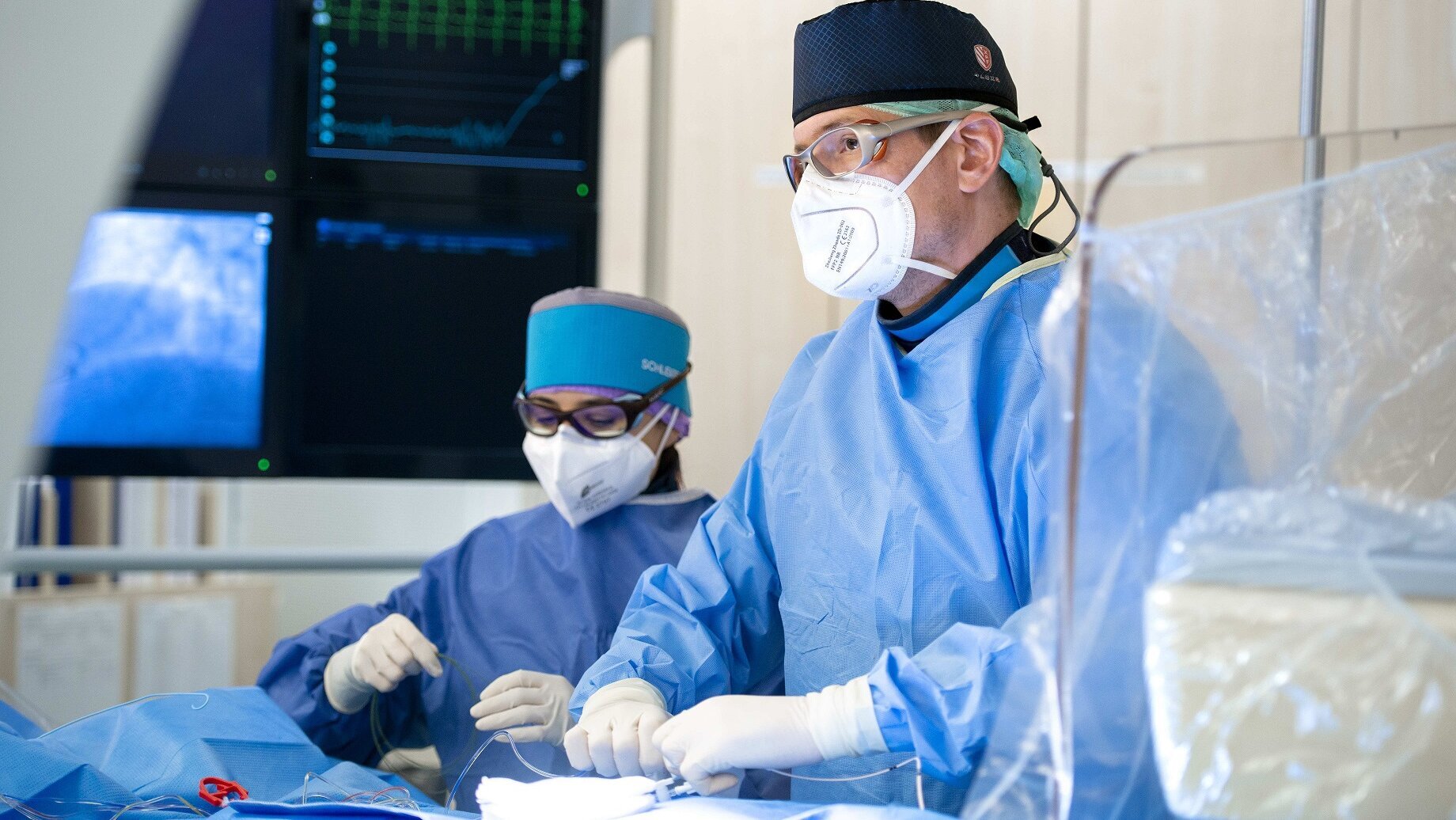
We carry out more than 800 procedures per year in our cardiac catheterisation laboratory. A particular focus is on the examination and treatment of newborns with critical congenital heart defects.
Range of services
We routinely perform these procedures, among others:
- Diagnostic cardiac catheterisation, pulmonary responsiveness testing for pulmonary hypertension, coronary angiography and biopsies,
- Balloon dilatations of all heart valves and vascular stenoses including high-frequency opening of pulmonary atresia and stent implantations,
- Implantation of stents (vascular supports) in vascular constrictions, isthmus stenoses, in the right ventricular outflow tract and the ductus arteriosus in duct-dependent heart defects,
- opening of the atrial septum and dilation of atrial septal defects,
- Closure of atrial septal defects and ventricular septal defects using implants,
- Closure of a persistent ductus arteriosus, also in premature babies weighing at least 1,000 grams,
- Reference centre for interventional pulmonary valve replacement (Melody, Sapien, VenusP, Harmony-Valve),
- Closure of vascular malformations of all kinds.
- Treatment of renal artery stenosis in children.
We also specialise in complex and post-operative interventions in a hybrid operating theatre. We work closely with our colleagues in cardiac surgery and electrophysiology.
Cardiac catheter examinations are carried out in a special treatment room with a state-of-the-art digital X-ray system. A general anaesthetic is not usually required. Targeted medication means that the examination can be carried out on the sleeping patient without pain or anxiety. Patients are continuously monitored during and after the examination.
Access to the cardiovascular system is usually gained via a puncture (needle puncture) of the blood vessels in the groin. Special catheters can then be placed in the required positions under fluoroscopy or ultrasound. Pressure measurements, blood sampling and angiographies are carried out at various locations. Clot formation is prevented by administering the active ingredient heparin. We have numerous different implants and balloon catheters to choose from in order to be able to offer our patients the best individualised treatment.
At the end of the examination, the puncture site is bandaged to prevent post-operative bleeding and removed after 24 hours at the latest.
We keep radiation exposure and X-ray exposure as low as possible during all cardiac catheterisation examinations.


Information for colleagues and referring physicians
- Clinical examination incl. RR measurement, SO2 monitoring, echocardiography
- 12-channel ECG, 24-72 h LZ ECG, 12-channel LZ ECG
- External event recorder
- Exercise ergometry / spiroerometry
- Treadmill
- Ergometer
- Tilt table examination
- Electrophysiological examinations
- Non-invasive diagnostic
- transoesophageal
- via device (SM, ICD)
- Mediakment tests (adrenaline, ajmaline, others)
- invasive diagnostic
- conventional
- 3 D mapping
- conventional (NavX Ensite X Precision)
- high resolution (NavX Ensite X Voxel)
- therapeutic
- Cryoablation (focal)
- RF ablation
- conventional (RFA)
- cooled (iRFA)
- Pressure sensor-controlled
- endocardial / epicardial
- Pulse field ablation (OA PD Dr A. Parwani)
- operative
- implantable event recorders
- 1, 2 and 3 chamber pacemaker / conduction system pacing
- 1,2 and 3 chamber ICD
- S-ICD
- Probe extraction
- LCSD (OA Dr A. Schneider, Paediatric Surgery, Charité)
- Non-invasive diagnostic
