
Telemedicine at the DHZC
The Cardiovascular Telemedicine Centre (TMZ) is an institution of the Medical Department of Cardiology, Angiology and Intensive Care Medicine at the Deutsches Herzzentrum der Charité.
We offer telemedical care for patients with chronic heart failure.
In our research projects, we research new telemedical methods, concepts and technologies for cardiovascular diseases together with our interdisciplinary project partners. We are interested in new research co-operations.
Telemedicine alongside outpatient and inpatient care
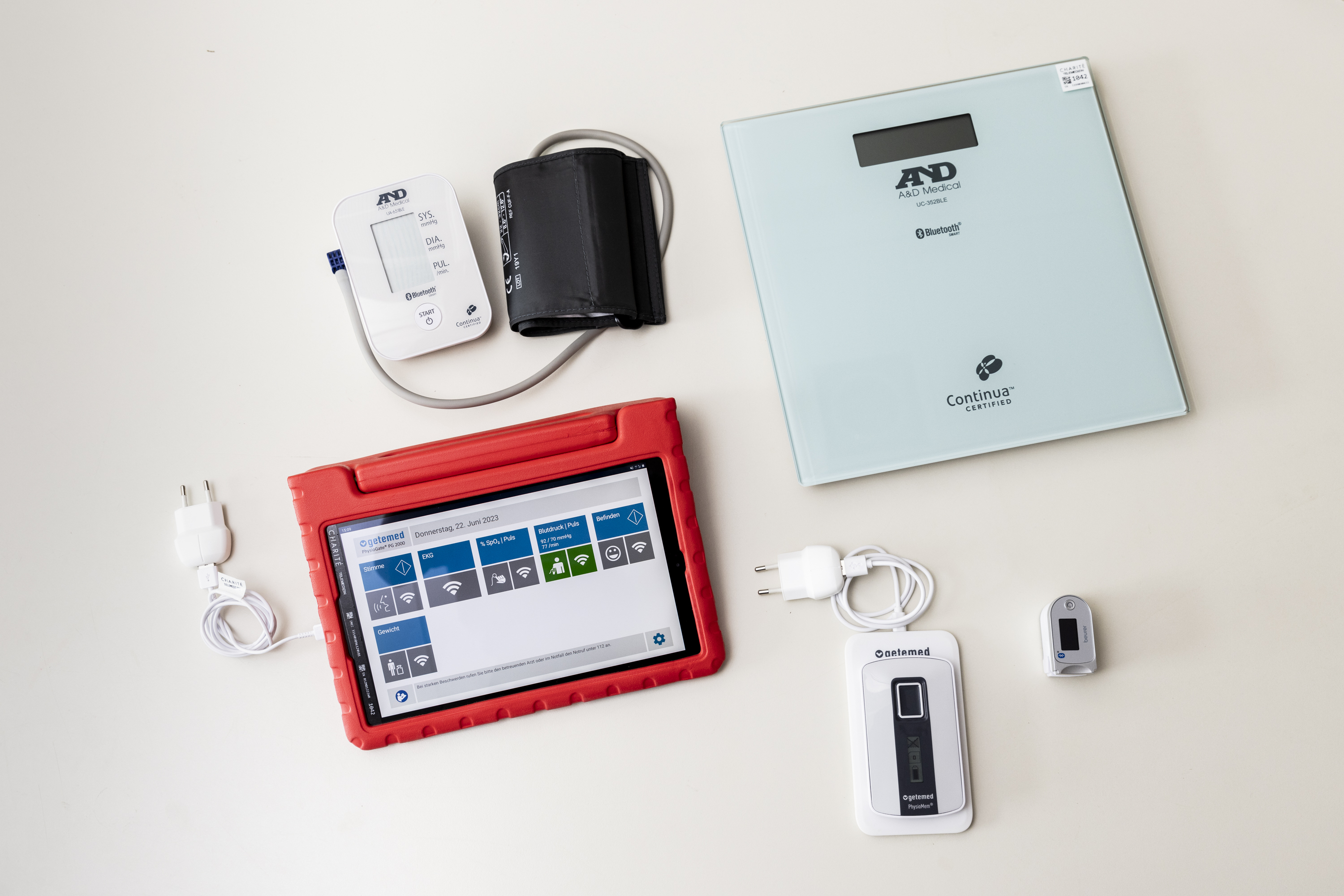
In contrast to face-to-face medicine, telemedicine uses telecommunications (e.g. mobile phones or the internet) to overcome the physical distance between patient and therapist. An example: A patient measures their blood pressure at home. The blood pressure monitor is equipped with a transmitter that automatically and wirelessly transmits the blood pressure values to a telemedicine centre staffed by doctors and nurses. Innovative transmission technologies from the telecommunications sector are used for this.
In a telemedicine centre, the medical staff promptly check the blood pressure values and other health parameters, such as weight or ECG. If there are any abnormalities, they contact the patient. Changes can thus be recognised early and medical treatment can be initiated in good time.
Telemedicine at the Charité
At the Charité, a concept for the telemedical care of patients with heart failure was developed, implemented and evaluated as part of a large study as early as 2005. It was shown that telemedicine has a positive effect on the course of the disease.
Telemedicine at the Charité
At the Charité, a concept for the telemedical care of patients with heart failure was developed, implemented and evaluated as part of a large study as early as 2005. It was shown that telemedicine has a positive effect on the course of the disease.
What forms of telemedicine are there?
- Telemedicine is used by doctors to transfer patient data, obtain second opinions and share knowledge (‘doc2doc’ telemedicine). It is used in continuing medical education, for particularly complicated cases or in remote areas.
- Telemedicine is also used in direct collaboration between doctors and patients (‘doc2patient’ telemedicine). This primarily involves monitoring health values, but also making diagnoses and initiating treatment where necessary.
Medical team
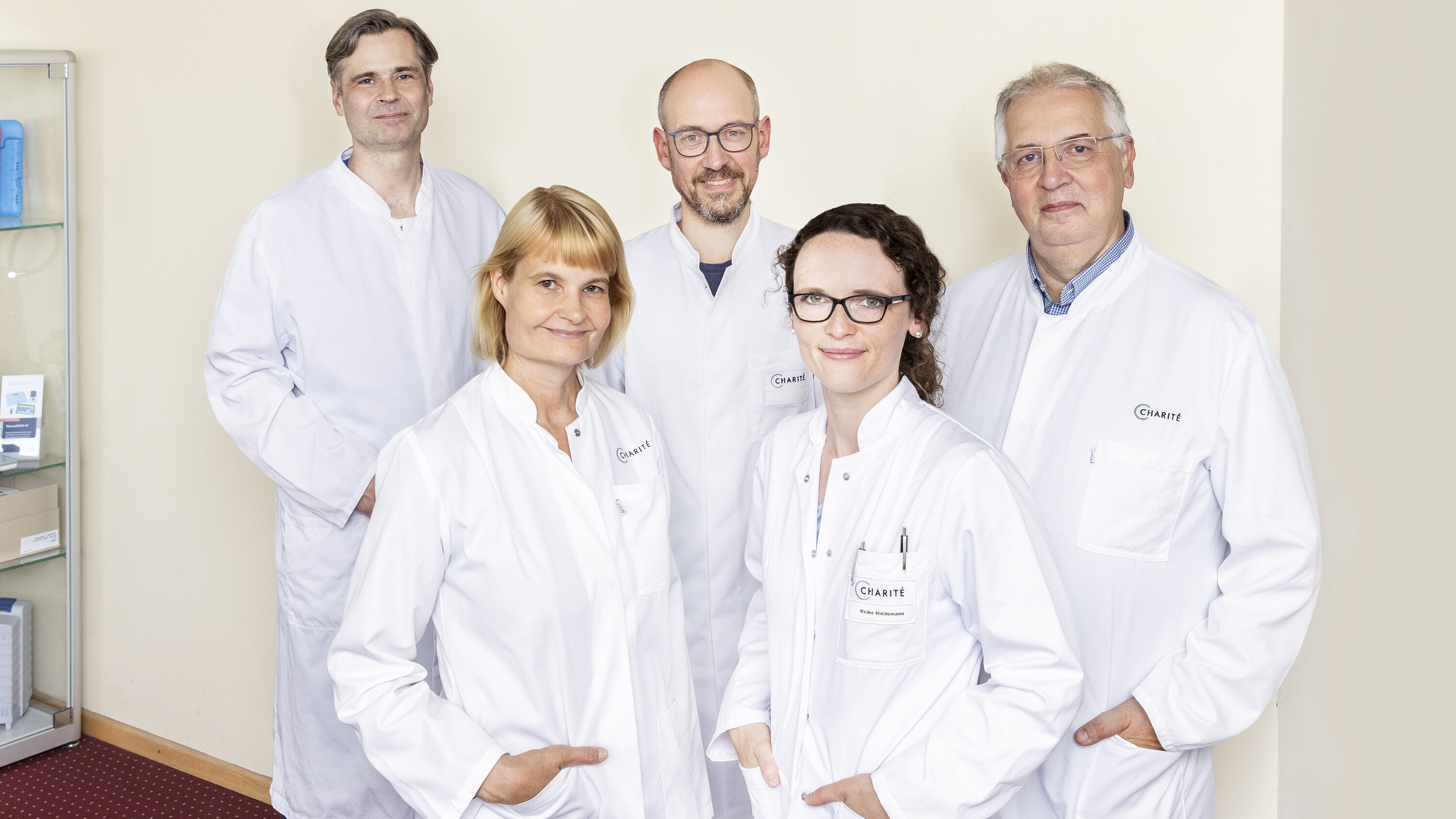
The medical team of the Cardiovascular Telemedicine Centre at the DHZC.
The team is headed by Prof. Dr Friedrich Köhler (far right in the picture).
(Image: DHZC/Vollmer)
Medical team
The medical team of the Cardiovascular Telemedicine Centre at the DHZC.
The team is headed by Prof. Dr Friedrich Köhler (far right in the picture).
(Image: DHZC/Vollmer)
Completed research projects
The TRICORDER consortium started at the beginning of October 2015 and ran until the end of September 2018. The project was funded by the German Federal Ministry of Education and Research as part of the ‘On-site analytics with photonic methods for use in the life sciences’ initiative. The joint partners were the Fraunhofer Institute of Optronics, System Technologies and Image Exploitation IOSB (Karlsruhe), getemed Medizin- und Informationstechnik AG (Teltow) and POLYTEC GmbH (Waldbronn).
The Centre for Cardiovascular Telemedicine was a clinical subcontractor of getemed Medizin- und Informationstechnik AG.
The Next Generation of Body Monitoring (NexGen) project aimed to develop key microelectronic technologies and components for future mobile/wearable healthcare systems. The feasibility was to be demonstrated using two interconnected, ubiquitous body monitoring systems: an implanted glucose monitor and a non-invasive, body-worn multi-parameter monitor.
This research project was carried out together with the Medical Clinic for Endocrinology and Metabolic Medicine (Clinic Director: Prof Dr Joachim Spranger).
Coordinator: Infineon Technologies AG, Munich, Germany
Funding volume Charité: approx. 710,000 EUR
The project was funded by the Federal Ministry of Education and Research over a period of ten years (2009-2018).
The FONTANE project aimed to improve the quality of care for cardiovascular patients in structurally weak rural areas through the cross-sectoral use of modern information technologies and biomarker-based diagnostics and therapy management. Process innovations such as the Point-of-Care@Home concept for biomarkers and product innovations such as a homecare platform and self-adaptive, prioritising middleware support the new care model.
Following product development, these were evaluated in the TIM-HF2 clinical trialfrom 2013 to 2018.
Total volume: approx. 21.2 million euros
BMBF funding volume Charité: approx. 9 million euros plus project allowance
The project was funded by the European Commission as part of the CIP-ICT-PSP.2012.3.4 programme between 2013 and 2016. The aim of the E-NO FALLS thematic network was to network knowledge, experience and best practice solutions in the field of fall prevention, intervention and safety at European and international level.
The main goal of E-NO FALLS thematic network is to integrate and bring together knowledge, experiences and best practices acquired at European and international level in the area of fall prevention, intervention and safety, with the aim of coordinating ongoing activities and creating the necessary conditions and consensus on action plans, standards and specifications in view to ensure the widest future replication and co-deployment of innovative solutions (with special emphasis on ICT-based ones). In this way, the E-NO FALLS thematic network will be a forum for all stakeholders within the value chain (such as industry, users organisations, informal and formal care providers, public authorities, investors, housing and insurance companies and service providers across Europe) to share knowledge, expertise, resources, best practice experiences and to build consensus to highlight the remaining obstacles to be overcome and to eventually provide guidance for ICT-enabled solutions and their roll-out. Therefore, E-NO FALLS is envisaged to act as a HUB in the sense that it will become a single point concentrating conclusions, references and links to all what is being/has been done in all issues (research results, policy recommendations, market uptake...) related to fall prevention, detection, intervention and safety. E-NO FALLS portal will provide links to other networks, projects and initiatives addressing Falls which will make easier to all stakeholders to have a view and gather information about trends and future initiatives and the opportunity to be involved in all the activities of the network. Furthermore E-NO-FALLS will commit to the EIP AHA A2 action on fall prevention and will actively support the implementation of the action plan. In the same sense E-NO-FALLS will collaborate with the other thematic network, PROFOUND, to ensure synergies and mutual collaboration. The output expectation of the network is to maximize the social and economic potential of ICT-based solutions, while promoting and accelerating wider deployments for improving quality of life and sustainability of care for the ageing population.
Coordinator of the overall project:
Technical Research Centre for Dependency Care and Autonomous Living
Knowledge Engineering Research Group
Universitat Politècnica de Catalunya
Neapolis Building, Rambla de l'Exposició, 59-69
08800 Vilanova i la Geltrú. Barcelona. Spain
Contact Charité: Sandra Prescher, sandra.prescher(at)charite.de
Total volume: 1 million euros
Funding volume Charité share: approx. 35,000 EUR
MAS is funded as part of the ENIAC JU joint venture and the Federal Ministry of Education and Research.
The MAS project is researching nano-electronic components and systems for AAL applications (health/wellness/patient monitoring). Charité supports the MAS consortium in system and application planning and implementation and, above all, carries out the relevant clinical studies on the realised systems in the form of clinical applications.
Total volume: approx. 28 million euros
Funding volume Charité share: approx. 0.5 million euros
Further information
PfH was funded by the Federal Ministry of Economics and Technology from 2005 to 2011.
The aim was to develop a telemedical device platform and evaluate it in a clinical study.
Total volume: approx. 12 million euros
Funding volume: 3.8 million euros
Further information
