Peripheral arterial occlusive disease (PAD)
Peripheral arterial disease (PAD), also known as intermittent claudication, is a condition in which the blood vessels that carry blood from your heart to your arms and legs become narrowed or blocked. This is often caused by the build-up of cholesterol and other substances on the walls of the arteries, which is known as atherosclerosis.
Risk factors
Smoking: Smoking is one of the main risk factors for PAD. The substances in tobacco can damage the arteries and lead to deposits that impair blood flow. Avoiding nicotine is advisable in any case and reduces the risk of a worsening of PAOD or its occurrence.
Diabetes mellitus: People with diabetes have an increased risk of PAD, as high blood sugar levels damage the blood vessels and favour deposits in the arteries.
High blood pressure: High blood pressure can cause the artery walls to be damaged by shear forces and deposits (plaques) to accumulate, which can impede blood flow.
High cholesterol: A high LDL cholesterol level can lead to deposits in the arteries, which can narrow them and impair blood flow.
Family history: If you have a family history of PAD, stroke or heart attack, you may have an increased risk of developing intermittent claudication.
Age: The risk of PAD increases with age, as the arteries lose elasticity over time and deposits can build up.
Lack of exercise: An inactive lifestyle can increase the risk of PAD, as exercise helps to promote blood flow and support arterial health.
Overweight or obesity: Being overweight puts a strain on the cardiovascular system and can lead to an increased risk of PAD, especially if it is associated with other risk factors such as diabetes or high blood pressure. Reducing obesity can often improve blood pressure and therefore reduce the risk of developing PAD or slow down the progression of the disease.
It is important to recognise these risk factors and try to control or reduce them to reduce the risk of PAD. This can be achieved by eating a healthy diet, exercising regularly, not smoking and controlling blood sugar, cholesterol and blood pressure levels. If you are concerned about your personal risk of PAD, it is best to discuss this with your GP. We will be happy to answer any further questions you may have regarding diagnosis and treatment.
Symptoms
If you suffer from intermittent claudication, you may notice various symptoms. A common sign is the feeling of pain or cramps in your legs while walking or during other physical exertion. This is known as ‘intermittent claudication’. This pain occurs because your legs are not receiving enough blood to support the increased muscle activity.
Another symptom may be that your legs become cold or pale, especially when you elevate your legs or lie down. This is because the narrowed or blocked blood vessel is restricting normal blood flow to your extremities. If this occurs suddenly and is associated with coldness and pain, you should go to the nearest emergency centre as soon as possible, as amputation could be imminent. In advanced, chronic cases, you may even develop ulcers or sores on your feet or legs, which can heal poorly and become infected.
It is important to recognise and treat PAD early, as untreated cases can lead to more serious problems such as tissue damage, infection or even amputation. Those with PAD also have an increased risk of developing other cardiovascular diseases such as coronary heart disease (CHD) or cerebrovascular disease (CVD, stroke).
If you notice any of these symptoms, you should definitely consult a doctor who can help you with diagnosis and treatment.
Diagnosis
Ankle-Brachial Index (ABI) or Ankle-Brachial Index: This is a simple and non-invasive test that measures blood pressure in the arms and legs to form a ratio of the two values. A low ABI indicates reduced blood flow and can be an indication of PAD.
TOPP method (Tissue Optical Perfusion Pressure): This method involves the simultaneous automated measurement of the ankle-brachial index and pulse wave index. With TOPP and ABI as an all-in-one screening method, patients with unknown or unconfirmed PAD are diagnosed earlier and treated sooner.
Transcutaneous partial pressure of oxygen (TcpO2): This non-invasive methodmeasures the partial pressure of oxygen in the tissue. This allows the microperfusion of the capillaries to be measured. In patients with chronic critical ischaemia with imminent risk of amputation or with chronic wound healing disorders due to PAD, this method can be used for therapy decisions and monitoring.
Doppler and duplex sonography: These imaging procedures use ultrasound to visualise the blood flow in the arteries and identify anomalies such as constrictions or occlusions. Duplex sonography is radiation-free and quickly available. Thanks to our high-end equipment, we have a very high resolution of the images, combined with our specialist expertise, we can diagnose up to 95% of vasoconstriction of the iliac arteries. In rare cases, the diagnosis must be extended with cross-sectional imaging (see below), particularly in the case of obesity.
Treadmill test: The treadmill test is a simple and non-invasive method to assess the extent of circulatory disturbance in PAOD and sometimes to determine the indication for invasive therapy in cases of variable symptoms. It can also be used to monitor the success of treatments and track the patient's progress over time.
Computed tomography (CT) or magnetic resonance imaging (MRI): These imaging techniques can also be used to obtain detailed images of the blood vessels and identify constrictions or occlusions. In some cases, this is a necessary diagnostic step for therapy planning.
Digital subtraction angiography (DSA): In this more invasive procedure, a contrast agent is injected into the arteries to visualise their structure and blood flow on X-ray images. This can help to determine the exact location and severity of the narrowing. We use angiography almost exclusively to treat the target lesion immediately after it has been found. Further information can be found on the CCM angiology page.
The choice of diagnostic procedures depends on several factors, including the patient's symptoms, medical history and the availability of resources at the medical facility.
Therapy
Conservative therapy
If a decision is made together with the patient in favour of conservative therapy, the focus is on controlling the above-mentioned risk factors with medication. In addition, structured gait training is essential to improve the pain-free walking distance. Structural gait training can be prescribed by the family doctor or vascular physician and serves to improve fitness and promote the formation of new blood vessels.
Interventional therapy
If you are diagnosed with PAD with the corresponding symptoms and the indication for treatment is given, many lesions can be treated endovascularly. This means that the vascular constrictions/occlusions can be reopened using a suitable vascular access under local anaesthetic, without unblocking the vessel. In many cases, it is sufficient to carry out a pre-dilation with a normal balloon and a final therapy with a drug-eluting balloon. If the therapeutic effect is insufficient, stent implantation may be necessary in some cases. In particularly severe cases with massively calcified vessels, vessel preparation with removal of plaque material is necessary in advance. Such a treatment method is known as atherectomy and is regularly performed in our catheterisation laboratory if there is a suitable indication for lasting good results.
(for further information, please see our range of invasive angiology services).
Due to unfavourable lesion localisation or lesion lengths for stent implantation, in some cases vascular surgery has advantages over an endovascular procedure. Such cases are regularly presented to our interdisciplinary vascular team and the best possible individual therapy is decided for you.
Authors

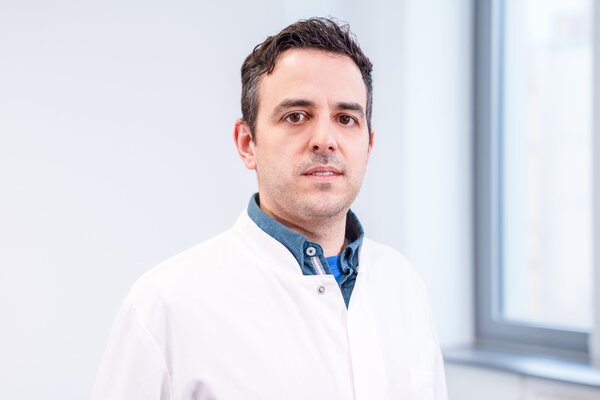
Dr Surath Perera is a specialist in internal medicine and cardiology and head of angiological functional diagnostics at the Department of Cardiology, Angiology and Intensive Care Medicine at the Deutsches Herzzentrum der Charité (DHZC).