Deep vein thrombosis
Deep vein thrombosis (DVT) is a condition in which a blood clot (thrombus) forms in the deep veins, usually in the legs. This often occurs when the blood flows more slowly than normal, when there is an obstruction to flow or when the blood composition changes, leading to an increased tendency to clot.
Causes
Immobilisation: Long periods of immobility, such as long flights, hospital stays or bed rest after an operation, can increase the risk of DVT as the blood flow slows down and the risk of blood clots forming increases.
Surgery: Surgery can increase the risk of DVT, especially if you are immobile for a long time during surgery or if the surgical procedure increases the risk of blood clots.
Injuries: Injuries, especially those that result in a fracture or contusion, can increase the risk for DVT because they can slow blood flow and promote blood clotting.
Pregnancy: Pregnancy increases the risk of DVT as the pressure on the pelvic veins increases and blood clotting factors can increase during pregnancy.
Contraceptives: Some forms of contraception, especially hormonal contraceptives such as the pill or hormonal patches, can increase the risk of DVT, especially in women who smoke or have other risk factors.
Obesity: Being overweight or obese can increase the risk of DVT as it can increase pressure on the veins and slow down blood flow.
Smoking: Smoking can increase the risk of DVT as it can promote blood clotting and the formation of blood clots.
Family history: If you have a family history of DVT, you may have an increased risk of developing the condition.
It is important to note that the presence of these risk factors does not necessarily mean that you will develop DVT, but they may increase your risk. If you are concerned about your personal risk of DVT, it is best to speak to your GP about it and if in doubt, please feel free to ask to be referred to us.
Symptoms
Symptoms of DVT can vary, but the most common include swelling, pain, discolouration or tenderness in a leg, particularly in the calf or around the knee. This may feel like a dull, pressing pain or an uncomfortable feeling of pressure.
Another possible symptom is a sudden change in the colour or temperature of the affected leg. It may feel warmer than the other leg or the skin may appear reddish or bluish in colour.
Diagnosis
Sometimes a DVT can develop without any recognisable symptoms. In such cases, and of course also in the case of symptoms, the diagnosis can be made or refuted using imaging procedures such as a compression ultrasound or a blood sample.
- Colour-coded compression ultrasonography (FKDS): Here, the veins of the legs or arms are visualised using ultrasound and the suspicious vein sections are examined in certain regions by applying careful pressure. This allows thromboses to be visualised very reliably. The method is gentle and does not harbour any relevant risks for the patient concerned
- Laboratory chemical diagnostics: Occasionally, certain coagulation substances such as the so-called D-dimers and other coagulation factors are also determined, primarily in order to rule out thrombosis with the greatest possible accuracy and certainty.
- Phlebography: If there is still uncertainty or if stent implantation is necessary in special situations, such as May Turner syndrome, MR phlebography or CT phlebography can also be performed. Here, the pelvic or central veins are visualised and the surrounding tissue is examined. This allows compression syndromes to be recognised and treatment to be planned
- Coagulation diagnostics: We work closely with our colleagues in coagulation medicine and haemostaseology. In the case of hereditary risk factors, our patients are referred to our colleagues and receive interdisciplinary care.
- Environmental diagnostics: If a thrombosis has occurred ‘out of the blue’ without the presence of favouring provocation factors, this may indicate a so-called paraneoplastic syndrome. In the event of such a suspicion, we advise our patients individually with regard to further diagnostics (ultrasound of the abdomen, CT/MRI, gynaecological or urological examination, gastrointestinal endoscopy, etc.).
Therapy
Anticoagulation (blood thinning)
In most cases, a purely medicinal therapy with so-called blood thinners is sufficient, which can dissolve the blood clot within a few months. The duration of therapy for isolated peripheral thromboses is usually 3-6 months. If there is an accompanying pulmonary embolism or the thrombosis is long-distance, treatment can sometimes be extended for a whole year. In any case, our patients are monitored by ultrasound during the course of treatment in order to assess the success of the therapy and adjust it if necessary.
Lysis/interventional thrombectomy
In the case of particularly pronounced findings, blood thinning alone may not be sufficient. Lysis is a particularly effective therapy for dissolving clots. This can be introduced locally via a catheter intervention in the relevant target region so that the thrombosis can be dissolved more easily. Sometimes the clots can also be removed by catheterisation (thrombectomy).
Stent implantation
If the conditions for a symptomatic compression syndrome are present, stent implantation can be performed in selected cases. The affected vein is kept open by the stent (vascular support) so that the outflow can function unhindered again.
Important emergency information
DVT is a serious condition as the blood clot can dislodge and lead to life-threatening complications such as pulmonary embolism if it travels through the vascular system to the lungs. It is therefore important to see a doctor immediately if you notice signs or symptoms of DVT, especially if you are at increased risk of this condition.
In acute cases, we recommend that you visit the emergency department. Please feel free to contact us about this by telephone.
Authors

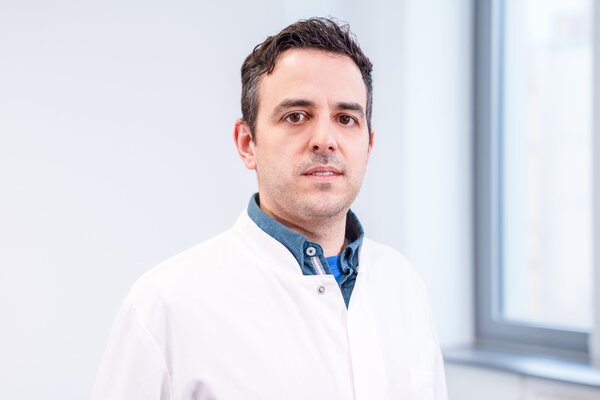
Dr Surath Perera is a specialist in internal medicine and cardiology and head of angiological functional diagnostics at the Department of Cardiology, Angiology and Intensive Care Medicine at the Deutsches Herzzentrum der Charité (DHZC).