Diseases of the mitral valve
The mitral valve is one of four heart valves. It separates the left atrium from the left ventricle and acts as a valve, ensuring that blood only flows from the atrium into the ventricle and does not flow back in the opposite direction. The shape of the mitral valve resembles a mitre (bishop's mitre) - hence its name.
The mitral valve consists of two leaflets, which are anchored in the left ventricle via the so-called chordae tendineae. These chordal cords prevent the leaflets from penetrating into the atrium. Thanks to this structure, the mitral valve allows blood to pass from the left atrium into the left ventricle and then prevents blood from flowing back into the atrium when the ventricle contracts.
The most common disease of the mitral valve in our country is mitral valve insufficiency. Mitral valve stenosis, on the other hand, is very rare in Europe today.
The mitral valve separates the left atrium from the left ventricle. It ensures that blood only flows from the atrium into the ventricle and does not flow back in the opposite direction.
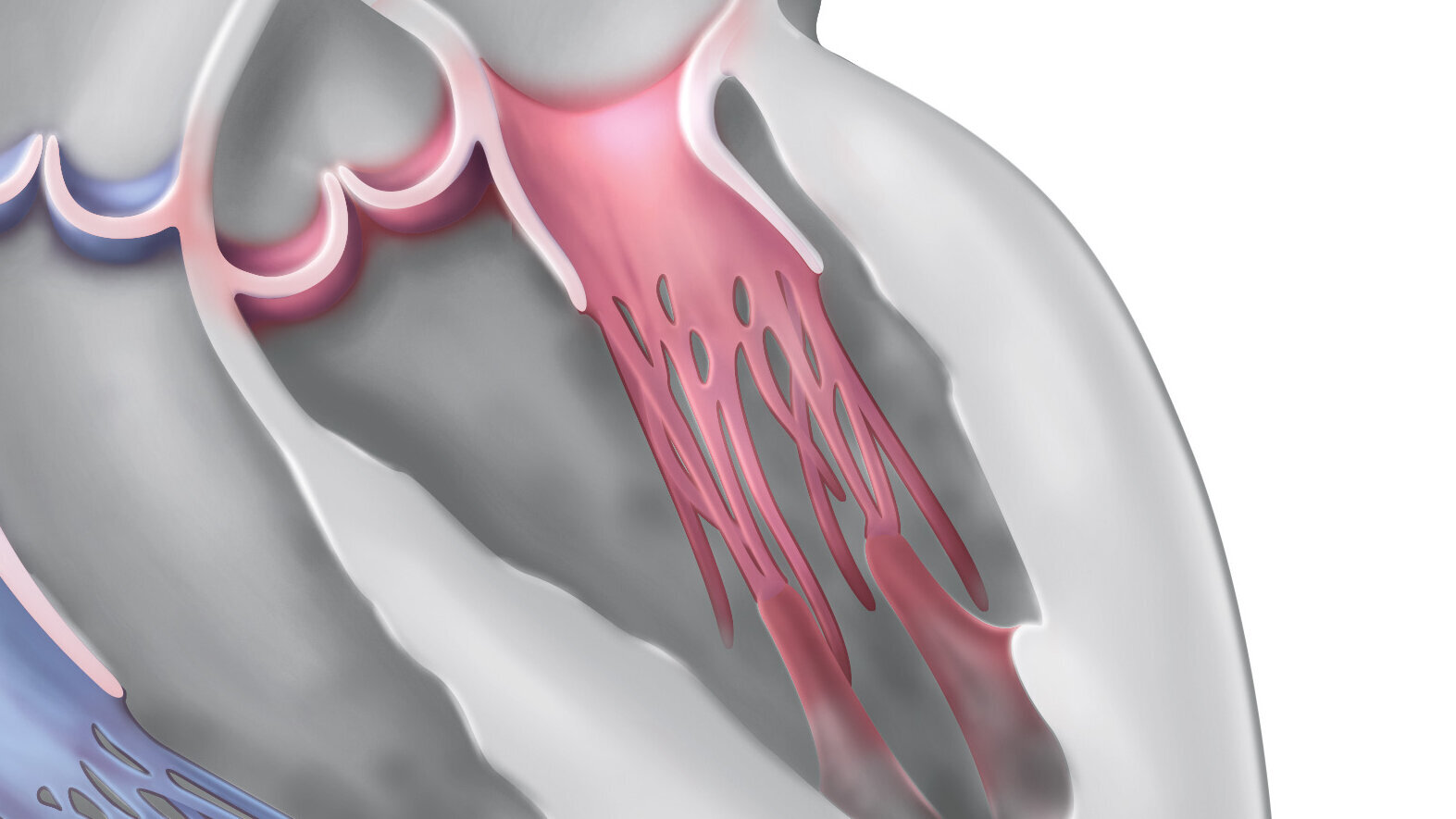
The mitral valve separates the left atrium from the left ventricle. It ensures that blood only flows from the atrium into the ventricle and does not flow back in the opposite direction.
Mitral valve insufficiency
Mitral valve insufficiency is the most common disease of the mitral valve. It occurs when the leaflets of the mitral valve no longer close properly. As a result, the blood that is supposed to be pumped from the ventricle into the systemic circulation partially flows back into the left atrium and, depending on the severity, leads to a backlog of blood in the pulmonary circulation. Patients notice this through increasing breathlessness.
Symptoms of mitral valve insufficiency
Insufficiency of the mitral valve often remains asymptomatic or even virtually symptom-free. If the mitral valve insufficiency is more pronounced, the following symptoms may occur:
- Shortness of breath, initially on exertion; as the condition progresses, worsening to shortness of breath at rest
- Abnormalities in the heart rhythm, e.g. palpitations, palpitations
- Urge to urinate at night
- Irritating cough that worsens when lying down
- Reduced performance
The symptoms can occur individually or in combination.
Causes of mitral valve insufficiency
Mitral valve insufficiency can be caused by degenerative processes (in simple terms ‘signs of wear and tear’) on the valve itself (primary mitral valve insufficiency) or by an enlargement and relaxation of the left ventricle, for example after a heart attack or due to heart muscle diseases (secondary mitral valve insufficiency): Due to the enlargement of the ventricle, the leaflets of the valves are ‘pulled apart’, as it were, and can no longer close tightly.
In patients suffering from primary mitral valve insufficiency, the mitral valve can be reconstructed or repaired in over 90 per cent of cases without the need to replace the valve with a prosthesis. In the case of secondary mitral valve insufficiency, this reconstruction rate is somewhat lower.
Diagnosis
At the DHZC, we offer patients various diagnostic procedures. The most important examination methods are
- Echocardiography, the ultrasound examination of the heart
- Electrocardiogram (ECG), the measurement of the electrical activity of the heart
- Magnetic resonance imaging
- X-ray of the chest
- Computer tomography
To prepare and plan an operation on the mitral valve, a scan of the coronary arteries (cardiac catheterisation or CT) is also performed to rule out any additional coronary heart disease.
You can find out more on our diagnostics page.
Mitral valve stenosis
If the leaflets of the mitral valve can no longer open sufficiently, this is known as mitral valve stenosis. The transition from the left atrium to the ventricle is narrowed, which impedes the flow of blood from the atrium into the left ventricle.
The disease is now rare in industrialised countries, as the most common cause - rheumatic fever - is almost non-existent there.
Mitral valve stenosis is characterised by shortness of breath, particularly at night and when lying down, as well as rapid fatigue under stress. As the disease progresses, the symptoms worsen to the point of breathlessness even at rest.
In most cases, mitral valve stenosis is caused by rheumatic fever, which is almost non-existent in industrialised countries. In addition, mitral valve stenosis can be congenital, caused by diseases such as lupus erythematosus (a chronic inflammatory autoimmune disease of the connective tissue) or by age-related signs of wear and tear (e.g. calcification).
In the case of mitral valve stenosis, repair is usually no longer possible - the valve must be replaced with a prosthetic valve.
To detect the disease, we carry out the following examination methods at the DHZC:
- Echocardiography
- Electrocardiogram (ECG): ECG stands for electrocardiogram and refers to the measurement of the electrical activity of the heart.
- X-ray of the chest
- Computer tomography
- Magnetic resonance imaging
Therapy for diseases of the mitral valve
Our teams have a wealth of expertise and experience: around 400 mitral valve reconstruction operations are performed at the Deutsches Herzzentrum der Charité every year, either in combination with surgical therapy for other heart diseases or as an isolated procedure. In the latter case, the procedure is almost always minimally invasive.
We have compiled detailed information on our mitral valve treatment page.