During a cardiac catheterisation, the coronary vessels and heart chambers are visualised on an X-ray screen using a thin plastic tube (catheter) and a contrast agent. This makes it possible to recognise circulatory disorders of the heart or disturbances in the pumping force. The catheter can also be used to measure the pressure in the heart chambers and in the pulmonary circulation (right heart catheterisation), which provides additional information about the severity of any heart valve defects.
Use cases
A cardiac catheterisation is the most important and often life-saving measure in the event of an acute heart attack. But even in cases of stable angina pectoris (‘chest pain’), PCI (percutaneous coronary intervention) with a balloon catheter and stent can significantly improve the patient's symptoms and quality of life. Open heart bypass surgery is no longer necessary in this case.
Cardiac catheters can be used to close ‘holes’ in the walls separating the heart chambers or to treat valve defects by dilating them. Cardiac catheterisation is a mandatory prerequisite before heart surgery.
Cardiac catheterisation is used at the DHZC to diagnose various cardiovascular diseases, but also to treat diseases or prepare for heart surgery. State-of-the-art cardiac catheterisation laboratories are available at the DHZC for this purpose.
(Image: DHZC/Vollmer)
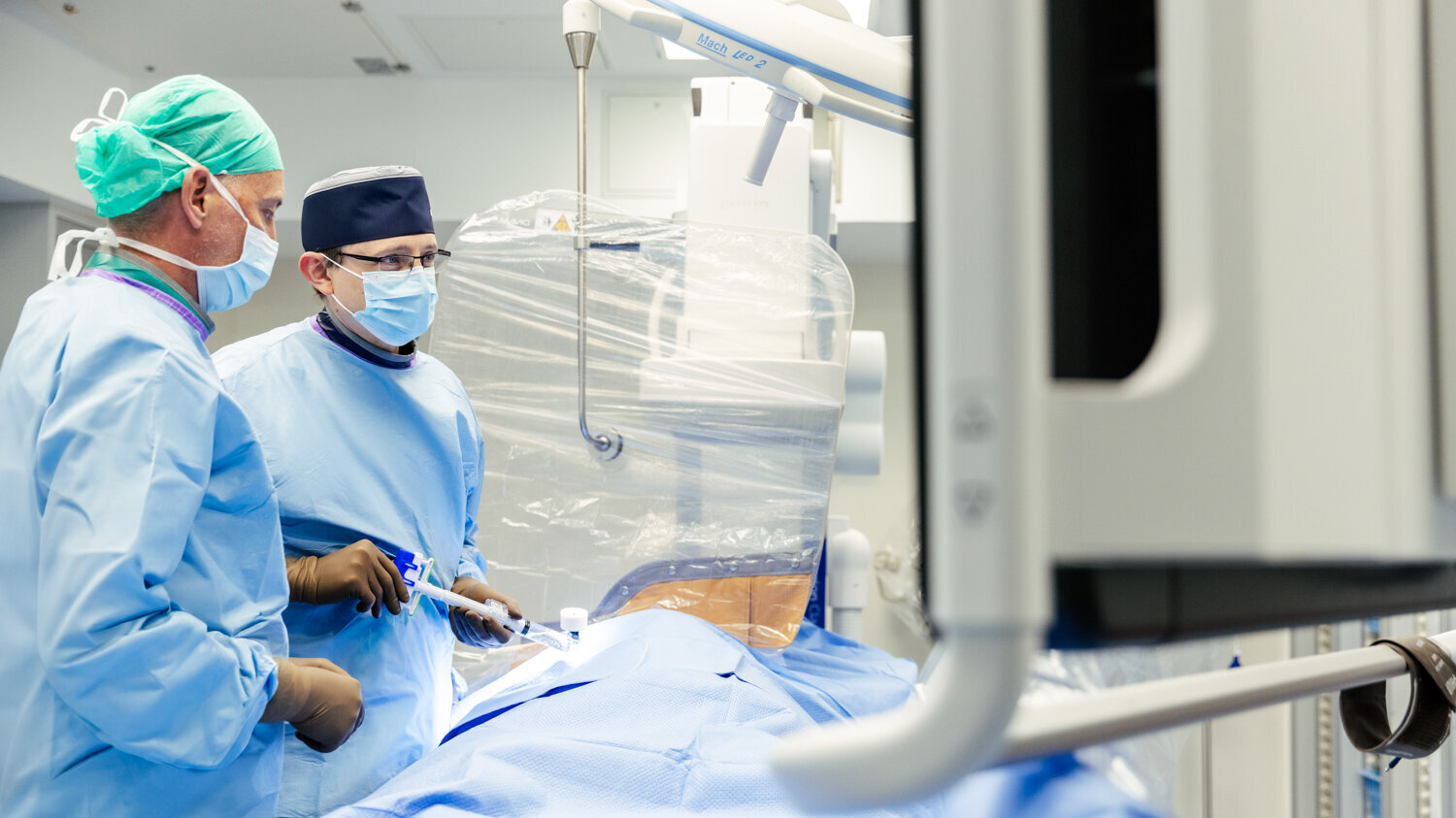
Cardiac catheterisation is used at the DHZC to diagnose various cardiovascular diseases, but also to treat diseases or prepare for heart surgery. State-of-the-art cardiac catheterisation laboratories are available at the DHZC for this purpose.
(Image: DHZC/Vollmer)
Cardiac catheterisation at the DHZC
State-of-the-art cardiac catheterisation laboratories are available for cardiac catheter examinations at all cardiology clinics of the DHZC. Our work focuses on the diagnosis and treatment of cardiac, vascular and conduction diseases in adults and children.
Our cardiac catheterisation physicians all have the additional qualification ‘interventional cardiology’ from the German Society of Cardiology (DGK). The Department of Cardiology, Angiology and Intensive Care Medicine is recognised as a training centre for interventional cardiology by the DGK.
Several hundred diagnostic or interventional cardiac catheterisation procedures are also performed by our doctors in the Department of Congenital Heart Desease - Pediatric Cardiology every year.
During a cardiac catheterisation, the coronary arteries and the heart chambers are visualised on an X-ray screen. In this way, circulatory disorders of the heart or disorders of the pumping force can be recognised.
(Image: DHZC/Külker)
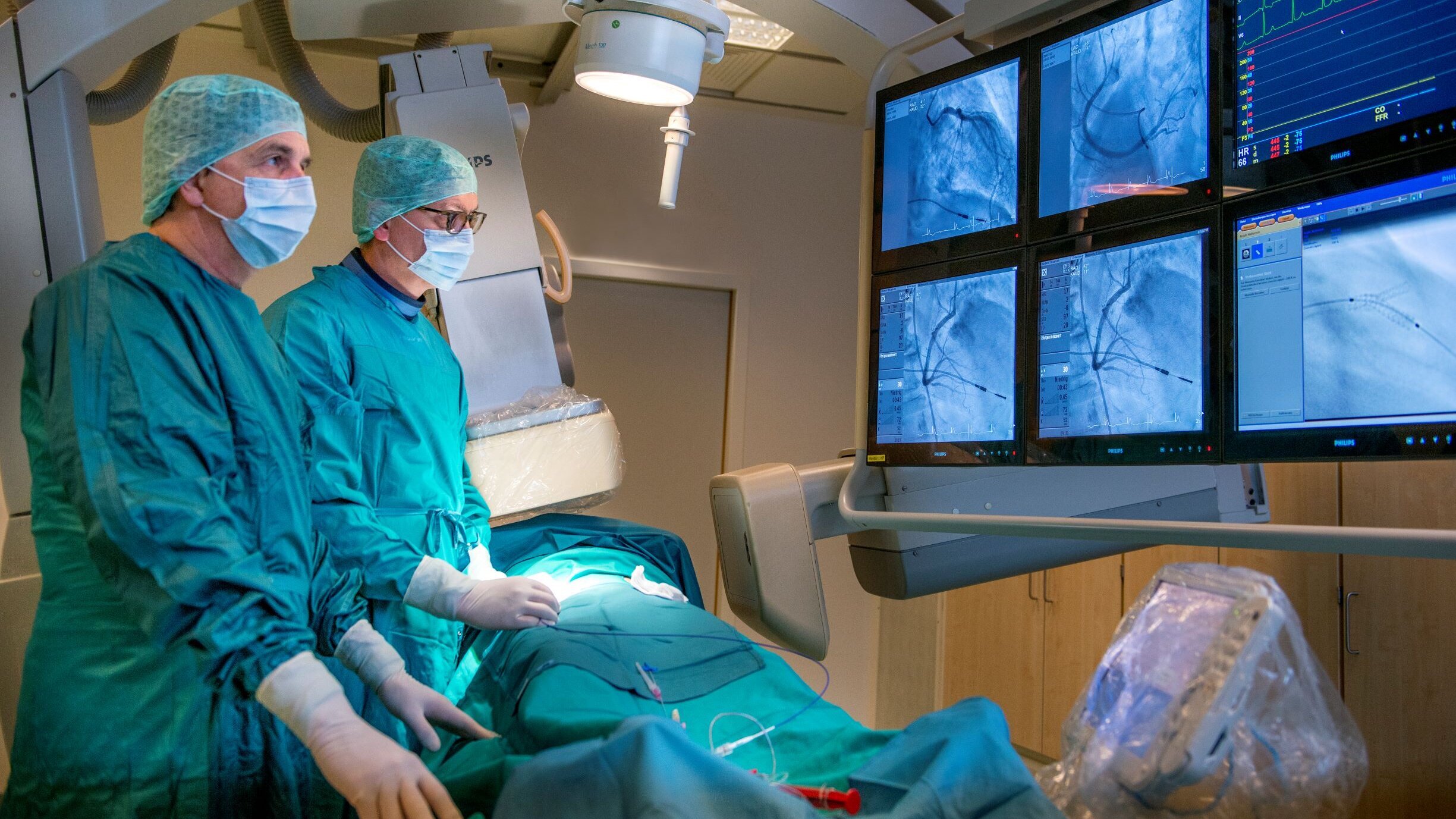
During a cardiac catheterisation, the coronary arteries and the heart chambers are visualised on an X-ray screen. In this way, circulatory disorders of the heart or disorders of the pumping force can be recognised.
(Image: DHZC/Külker)
Procedure
How exactly does the cardiac catheter work?
The thin plastic tube (catheter) is inserted into the heart after a local anaesthetic under X-ray control. For a left heart catheterisation, the catheter is inserted via an artery (artery) at the wrist or in the groin region; for a right heart catheterisation, it is inserted via a vein at the wrist or in the groin region. Pressure recordings are made and then X-ray contrast medium is injected to visualise the vessels or heart cavities.
Constrictions (stenoses) are treated using a balloon catheter and/or stent (‘vascular support’). A very thin wire is first inserted via the catheter into the affected vessel and through the constriction, on which a balloon or balloon with stent is then positioned precisely in the constriction under X-ray control. The balloon is then expanded using a pressurised syringe, which dilates the site and the stent is inserted immediately.
As a rule, constrictions are treated with a stent, which ensures significantly better long-term success compared to balloon expansion alone. The success can be seen immediately afterwards by administering contrast medium again. Sedation is not normally necessary, but can of course be administered.
Once the examination is complete, the cardiac catheter is removed and the puncture site is closed. The patient can get up again after just a few hours.
Minimally invasive procedure
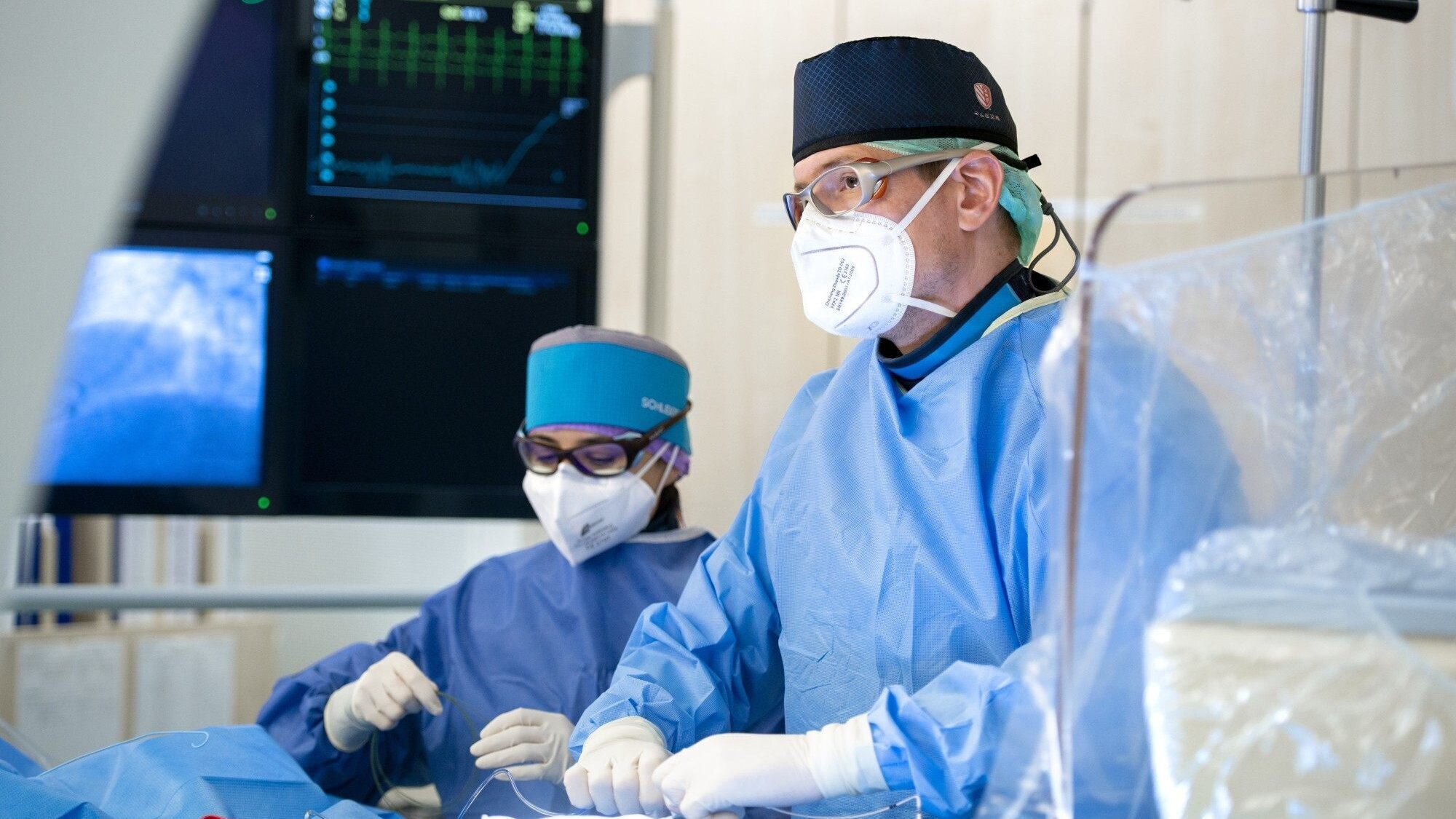
During a cardiac catheter examination, a thin plastic tube is advanced to the heart under X-ray control after a local anaesthetic. Access is gained via a vein at the wrist or in the groin region.
Minimally invasive procedure
During a cardiac catheter examination, a thin plastic tube is advanced to the heart under X-ray control after a local anaesthetic. Access is gained via a vein at the wrist or in the groin region.
Electrophysiological examination (EPU)
Electrophysiological examination (EPU) is a special form of cardiac catheter examination. You can read more about this on our EPU & ablation page.