Cardiac catheterisation laboratory
An important focus of our cardiac catheterisation laboratory is the treatment of patients with coronary heart disease, i.e. narrowing of the large (epicardial) coronary arteries. Coronary heart disease can manifest itself in the form of stable chest pain (angina pectoris), but can also lead to an acute heart attack. In addition to changes in the epicardial vessels, the small heart vessels that are not visible during cardiac catheterisation can also be affected. Seizure-like constrictions (spasms) of the large epicardial and small coronary vessels can also lead to chest pain (angina pectoris).
Management
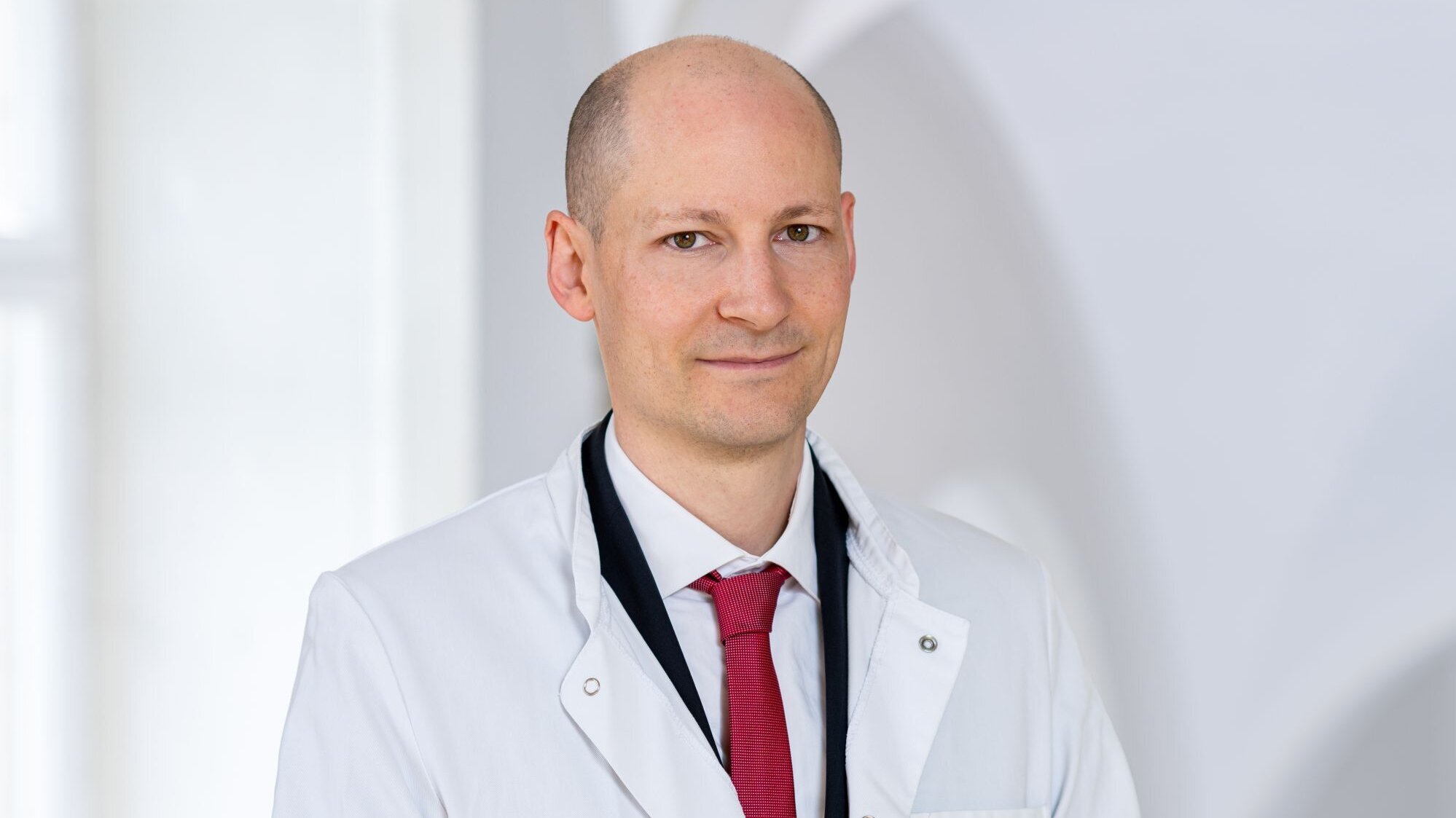
Our cardiac catheterisation laboratory is headed by PD Dr Felix Hohendanner.
Management
Our cardiac catheterisation laboratory is headed by PD Dr Felix Hohendanner.
Diagnostics
Coronary angiography is performed in the cardiac catheterisation laboratory to diagnose coronary heart disease. A catheter is inserted into the heart via an access port in the wrist or groin. This allows direct visualisation of the vessels by injecting contrast medium into the coronary arteries. For further diagnosis of narrowing (stenosis) of the coronary arteries, we have other modern procedures at our disposal. These include
- Pressure wire measurement (FFR), which can be used to directly measure the relevance of a narrowing.
- Optical coherence tomography (OCT), with which the inner surface of the coronary vessel can be visualised and measured using a special light source.
- Intravascular ultrasound (IVUS), with which a miniaturised ultrasound probe allows precise analysis of the vessel wall directly in the vessel.
- Coronary flow reserve measurement (CFR), with which the flow in the vessel can be measured and an increase in microvascular resistance can be determined in the event of structural changes in the small and smallest vessels.
- The acetylcholine provocation test, which can be used to diagnose vasospastic macrovascular or microvascular angina pectoris.
Cardiac catheterisation team
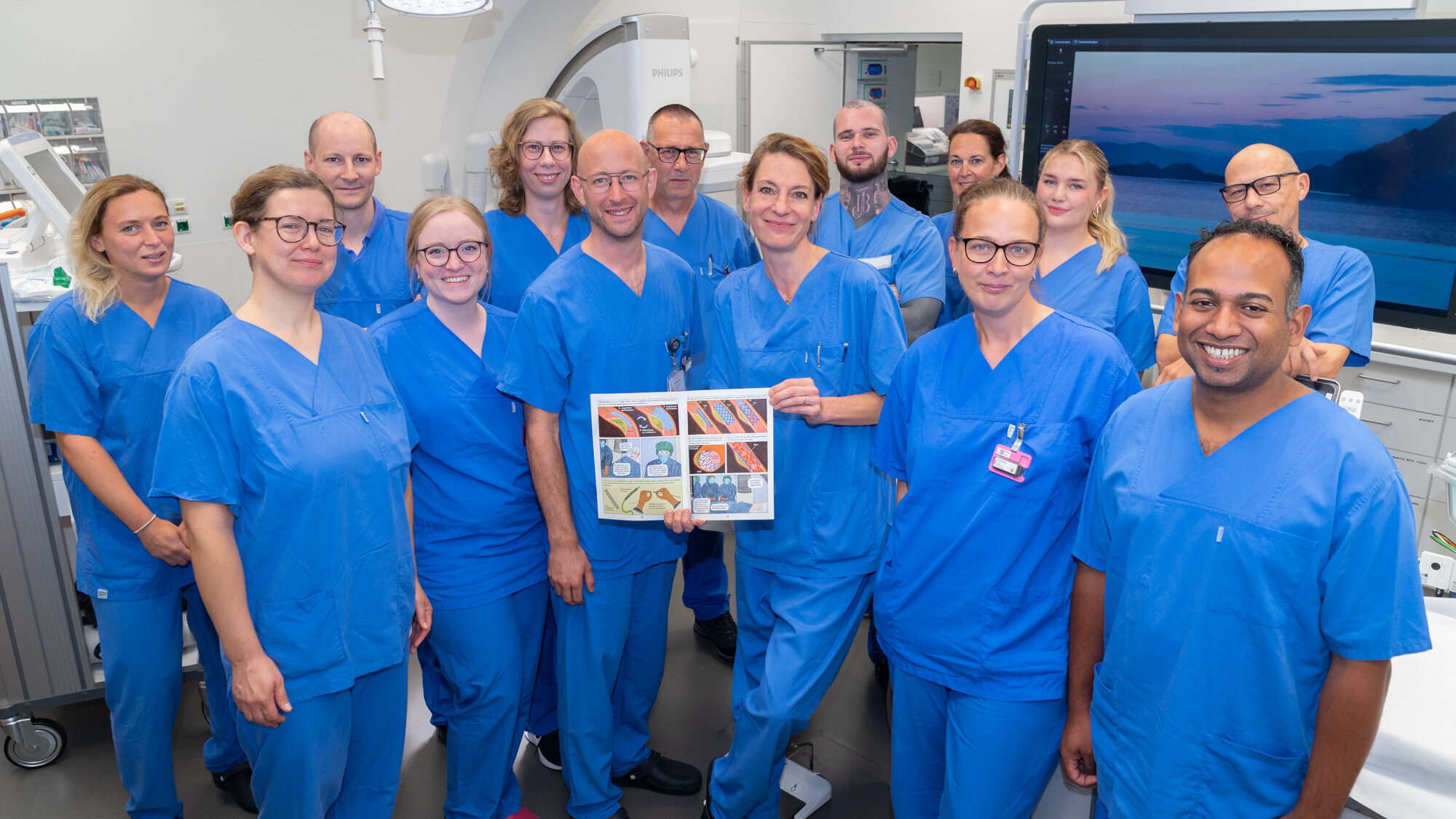
The team of the cardiac catheterisation laboratory of the Department of Cardiology, Angiology and Intensive Care Medicine at Campus Charité Mitte.
The colleagues also use comics to inform patients about the upcoming procedure and everything they need to know about a cardiac catheterisation. The aim is to allay patients' fears, provide them with comprehensive information and increase their satisfaction with the procedure.

Cardiac catheterisation team
The team of the cardiac catheterisation laboratory of the Department of Cardiology, Angiology and Intensive Care Medicine at Campus Charité Mitte.
The colleagues also use comics to inform patients about the upcoming procedure and everything they need to know about a cardiac catheterisation. The aim is to allay patients' fears, provide them with comprehensive information and increase their satisfaction with the procedure.
Therapy
Once coronary heart disease has been diagnosed, treatment is often possible directly in the cardiac catheterisation laboratory. For this purpose, constrictions (stenoses) of the coronary arteries are widened with balloons and treated by implanting a stent (a vascular support). In addition to drug-eluting stents, special drug-coated balloons are also used for certain changes, such as constrictions in a stent that has already been placed.
For particularly ‘hard’ cases, in which pronounced calcifications of the vessels cannot be adequately pretreated even with high-pressure balloons, we have special balloons for debulking (scoring or cutting balloon), intravascular lithotripsy or rotablation, in which the vessel can be widened using tiny drill heads. The use of intravascular imaging, such as OCT and IVUS, enables the accurate selection of stent and balloon sizes as well as precise procedure planning, exact lesion preparation and detailed visualisation and the best possible optimisation of the result after stent implantation (‘precision PCI’).