
Experience heart medicine up close
Clinical traineeships and practical year (PJ) at the DHZC
Are you interested in completing a clinical traineeship or your ‘internal’ or surgical final year clinical traineeship in one of Germany's leading centres for cardiac medicine? Then you've come to the right place – and welcome!
The following applies:
Clinical traineeships can be applied for individually and easily at any time. Simply send an email to the respective clinic; you will find the addresses below.
Our final-year placements are allocated via the portal www.pj-portal.de. We currently offer the following final-year placements:
- Five places in the Department of Cardiothoracic and Vascular Surgery
- One place in the Department of Cardiology, Angiology and Intensive Care Medicine at Campus Benjamin Franklin
- One place in the Department of Cardiology, Angiology and Intensive Care Medicine at Campus Charité Mitte
- one place in the Department of Cardiology, Angiology and Intensive Care Medicine at Campus Virchow-Klinikum
- one to two places in the Department of Congenital Heart Desease – Pediatric Cardiology
The practical year (PJ) in the winter semester begins in November, and the PJ in the summer semester begins in May.
Within a surgical or cardiological tertial, rotations in our Department of Congenital and Pediatric Heart Surgery are possible. Unfortunately, we are unable to offer complete tertials in this clinic.
In paediatric cardiology, you can apply for half a tertial in paediatric cardiology via the PJ portal. You will then be assigned to ward WD4 or ward 24i.
Content, processes, opportunities
The final year of the PJ is based on a pre-defined rotation plan: This should give you the opportunity to get to know all areas of the respective clinics:
- In surgery, the WDH1 and WD2 wards, our transplant ward WD3, the intensive care units, outpatient clinics and, of course, the eight operating theatres.
- In cardiology, the nursing ward WDK1, the outpatient clinic and the numerous functional areas such as the cardiac catheter and electrophysiology laboratories.
In each area, you will have a permanent point of contact and a clear workload of opportunities and duties.
Once a week, there is a special class for final-year students. Of course, you are also invited to participate in the clinics' regular continuing education events.
And last but not least: lunch in our staff restaurant is on the house for ‘PJler:innen’!
As a general rule, we welcome initiative and flexibility! Particularly in the surgical field, large numbers of staff have to be called upon or rearranged at short notice for unplanned procedures such as a transplant or for emergencies such as an aortic dissection.
Contacts
| Clinic | Options | Contact | E-Mail-Adresse |
|---|---|---|---|
| Chirurgie | Famulatur/PJ | Sümeyra Inal | herzchirurgie@dhzc-charite.de |
| Kardiologie CBF | Famulatur/PJ | Selin Kiratli, Sabine Grams | kardio-cbf@dhzc-charite.de |
| Kardiologie CCM | Famulatur | Diana Noguera Cender | kardiologie@dhzc-charite.de |
| Kardiologie CVK | Famulatur/PJ | sekretariatkardiologie@dhzc-charite.de | |
| Kinderkardiologie | Famulatur/PJ | kika-personal@dhzc-charite.de | |
| Kinderherzchirurgie | Famulatur | Daniela Peters | kinderherzchirurgie@dhzc-charite.de |
| Kardioanästhesiologie | Famulatur | Kerstin Pauli, Linda Bille | caiteam@dhzc-charite.de |
Further interesting links for the practical year
General information from LaGeSo about the practical year:
https://www.berlin.de/lageso/gesundheit/berufe-im-gesundheitswesen/akademisch/aerztin-arzt/artikel.114543.php
Information for Charité students about the final year:
Our ratings:
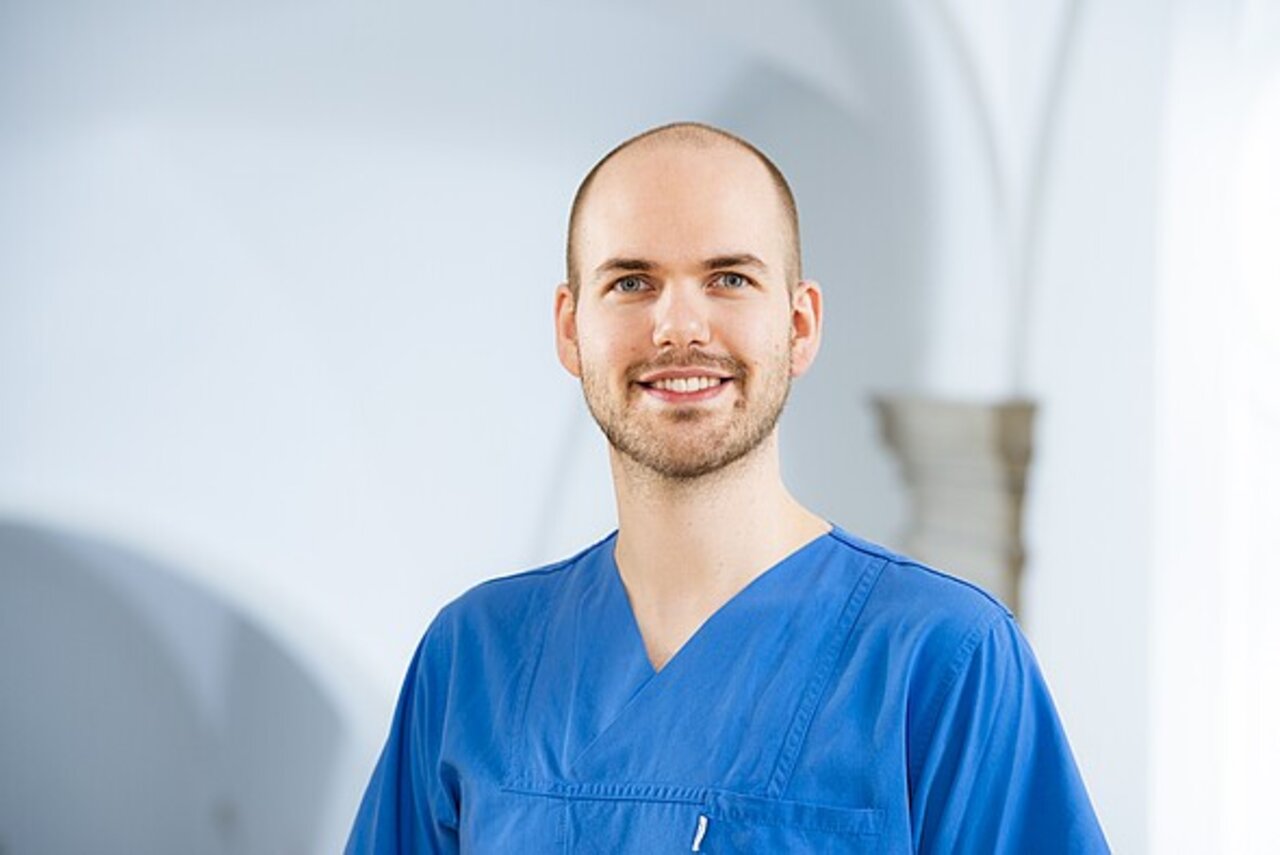
Interview with Emanuel Heil
Emanuel Heil did his final year of medical school with us at the Heart Centre in 2019. Since 2021, he has been working as a doctor in training to become a specialist (assistant doctor) at our WDK1 ward.
Why did you choose to do your final year of medical school with us?
I studied medicine at the Charité and got to know the heart centre from the inside for the first time as part of an examination course in the 7th semester. Not only did I get to experience the entire spectrum of cardiac diagnostic and therapeutic medicine at first hand, but I also got a very good first-hand impression of the hospital. So the idea of applying for a final year internship here at the hospital took root.
On which ward did you complete your final year internship?
During my internship, I was assigned to the WDK1 ward. Here, patients are cared for before and after various examinations such as EPU, implantation of pacemaker systems and minimally invasive aortic valve surgery. One focus is also on the care of people with myocardial diseases, which if left untreated can lead to severe heart failure.
Do you remember your first day of work as a final-year student?
My first day of work was a quiet Monday, when I accompanied the assistant doctor on duty during an admission. During the first few days, I was slowly introduced to the work on the ward and got to know my colleagues and the processes on the ward.
How was your final year structured?
In the mornings, I mainly worked on my ward. After the induction, I carried out admissions independently and then discussed them with the doctors. I also took part in ward rounds and took blood samples.
I was able to plan my afternoons freely and got to know many different areas of the hospital. I often visited the cardiac catheterisation laboratory, the electrophysiological examinations and the operating theatre. The atmosphere in the hospital is very open and students are warmly welcomed everywhere. I saw and learned something new every day – that kept me very motivated throughout the entire time.
Which moments during your clinical traineeship have remained particularly memorable for you?
Definitely my first time at the cardiac catheterisation table with Professor Philipp Stawowy. Before that, I had ‘only’ observed the procedure in the control room. The possibilities of interventional techniques in cardiac medicine are fascinating!
I also found the very collegial exchange in the hospital to be particularly positive. The doctors were very open and helpful to me and took time to answer my questions. I also found the close cooperation with my nursing colleagues very valuable. This is certainly something that makes the Heart Centre stand out.
Do you have any advice for prospective final-year students?
If you have a passion for heart medicine, you're in good hands here. My tip: don't be afraid to ask questions! If you show commitment and interest, the doors here will be wide open to you.
Interview with Luise Röhrich
In 2019, we talked to our former intern Luise and Prof. Felix Schönrath, MD, cardiological director and senior physician in the areas of severe heart failure and heart transplantation at our Department of Cardiothoracic and Vascular Surgery, about the internship at our hospital.
Today, Luise is working as a resident at our Department of Cardiothoracic and Vascular Surgery.
