Bypass surgery
In a bypass operation, the body's own vessel is transplanted in order to bridge constrictions in coronary arteries.Here you can find out how a bypass operation works and which variants we perform.
The heart muscle is supplied with blood by the coronary arteries. They originate close to the heart from the aorta, the body's main artery. If deposits form in the coronary arteries that partially or completely obstruct the flow of blood, this is known as coronary heart disease. The most important symptom, the feeling of ‘chest tightness’, is known as angina pectoris. If an area of the heart no longer receives enough blood, this can result in the death of muscle tissue and thus a heart attack. The heart attack leads to reduced pumping capacity of the heart; it can also lead to life-threatening arrhythmias and failure of the heart valve function.
What is a bypass?
In general, a bypass is a newly created pathway that bypasses narrow points in the vessel - like a ‘bypass’. In the heart, these narrowed passages are located in the coronary arteries and may prevent the heart muscle from being supplied with sufficient oxygen and blood. Cardiac surgeons use the bypass to restore the supply.
The bypass itself consists of the body's own tissue. Doctors decide whether leg veins, arm arteries or chest wall arteries are suitable for the heart bypass. Depending on which coronary arteries have a narrowing, the specialists determine the exact surgical technique.
A bypass (‘diversion’) of the heart leads the blood past a narrow section of the coronary arteries. In this way, the blood flow can continue to be ensured and the heart muscle receives enough blood and oxygen again.
A bypass (‘diversion’) of the heart leads the blood past a narrow section of the coronary arteries. In this way, the blood flow can continue to be ensured and the heart muscle receives enough blood and oxygen again.
When is bypass surgery necessary?
In many cases, narrowing of the coronary arteries can be widened using a balloon catheter. With the help of a metal mesh (stent), an attempt is made to keep the dilated area open in the long term. The treatment is carried out by means of a puncture in the wrist or groin via a catheter inserted into the coronary arteries. An operation on the heart is not necessary (find out more here).
However, if several coronary arteries are diseased or if dilation using a catheter is not possible, a bypass operation must be performed.
Procedure of a bypass operation
- Bypass surgery is performed under general anaesthetic.
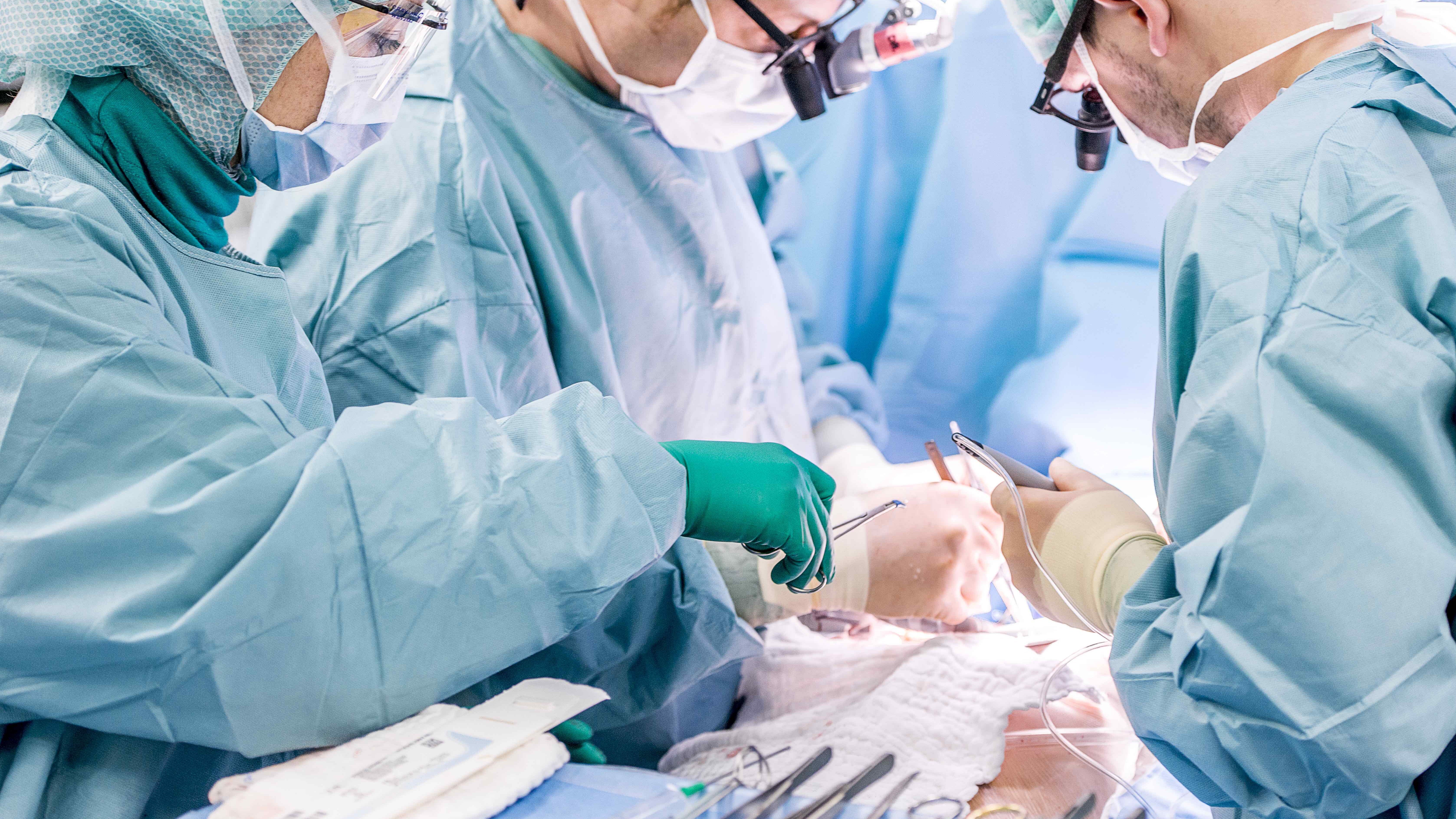
- In conventional bypass surgery, the sternum must be opened lengthways. The surgeon then exposes the heart and connects it to the heart-lung machine via tubes. This takes over the blood circulation/supply of oxygen and nutrients to the body, only the heart is immobilised with a special electrolyte solution (‘cardioplegia solution’).
- The surgeon can now begin to perform the actual bypass . The left internal mammary artery is usually used for this. In Latin, this artery is called the ‘internal mammary artery’; the operation is therefore often referred to as a LIMA bypass (left internal mammary artery).
- This artery runs along the inside of the chest wall close to the heart. It is exposed and "rerouted ’ to the heart - i.e. only cut at one end and then connected to the coronary artery behind the constriction.
- The body can easily compensate for the ‘loss’ of this artery at the extraction site.
- Instead or in addition, an artery in the arm, the "radial artery ’, can also be used as a bypass. The required section is cut at both ends, removed from the arm and then sutured to both the aorta and the affected coronary vessel - behind the constriction.
- At the DHZC, the radial artery is usually removed endoscopically, i.e. through a small incision in the wrist. This reduces pain and the risk of wound healing disorders and leaves only a small scar. Veins from the leg can also be used as a bypass.
- Once the bypass has been successfully applied, the heart is supplied with blood again and the heart-lung machine can be removed.
- Finally, several suction drains are inserted into the chest to drain wound secretions to the outside in the first few days after the operation.
- The chest is then closed again. The patient is then monitored in intensive care.
The duration of bypass surgery depends, among other things, on how many constrictions need to be bypassed and which of the surgical procedures described is required. It usually takes between three and four hours.
Use of the heart-lung machine
In a conventional bypass operation, the exposed heart is connected to a heart-lung machine that supplies the body with oxygen and nutrients. The heart itself is at a standstill during the operation.
The function of the heart-lung machine is monitored by perfusionists.
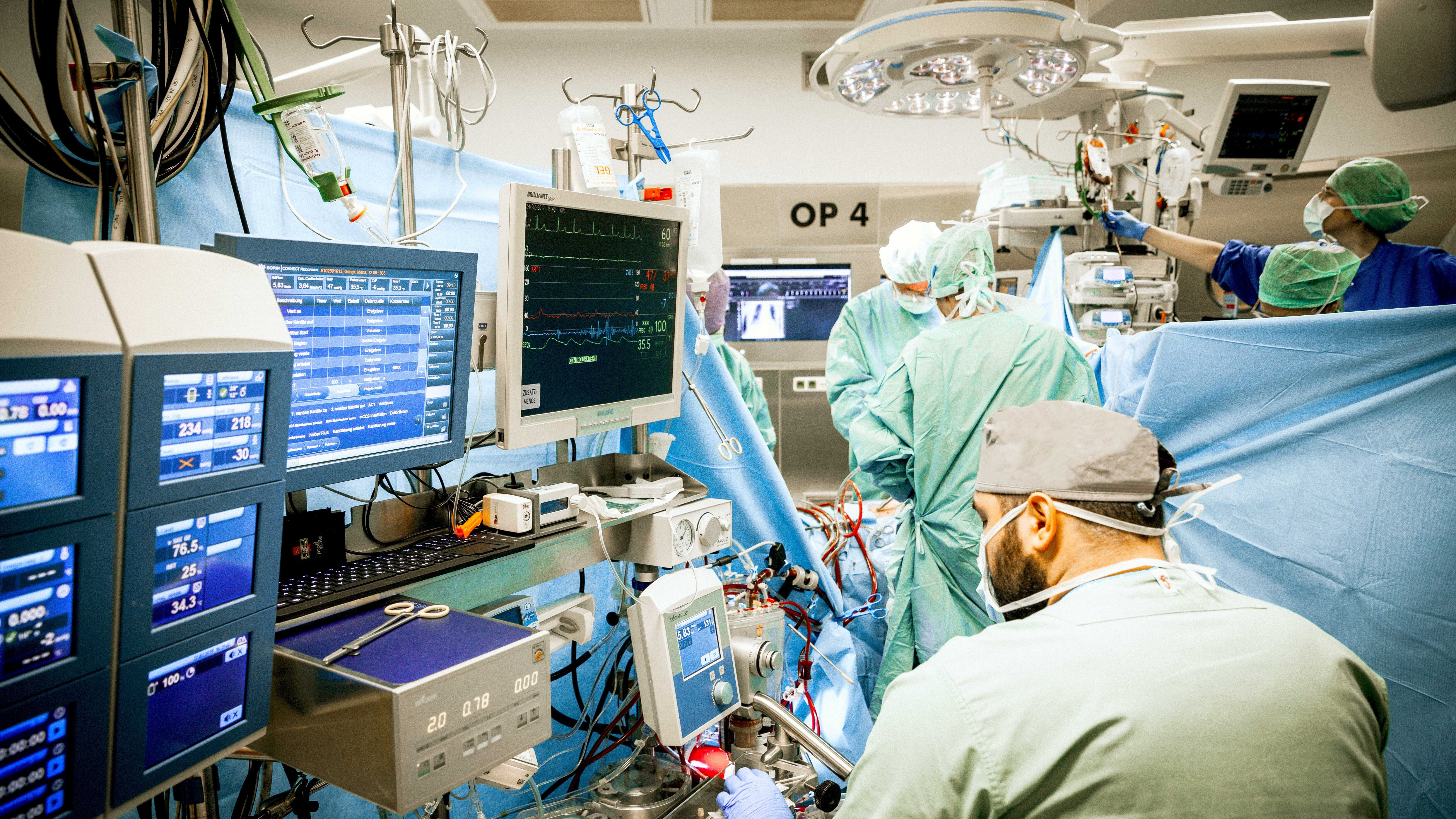
Use of the heart-lung machine
In a conventional bypass operation, the exposed heart is connected to a heart-lung machine that supplies the body with oxygen and nutrients. The heart itself is at a standstill during the operation.
The function of the heart-lung machine is monitored by perfusionists.
Modern variants of bypass surgery at the DHZC
Bypass surgery on the beating heart
In the past, bypass surgery was only possible on a stopped heart using a heart-lung machine. Today, bypass surgery at the DHZC can also be performed on a beating heart in many cases. The use of a heart-lung machine is therefore no longer necessary, which reduces the risk of complications and usually contributes to a faster recovery and shorter hospital stays.
Minimally invasive bypass surgery
At the DHZC, the procedure can also be performed minimally invasively for certain patients through a small incision under the left nipple. It is then no longer necessary to cut through the sternum. This ‘minimally invasive direct coronary artery bypass surgery’ reduces the risk of complications during the operation.