The DHZC becomes a magnet clinic
The concept of "magnet clinics" was developed in the USA in the 1980s. A shortage of nursing staff, dissatisfied staff and poor quality of care were the rule rather than the exception.
But not everywhere: some clinics had both satisfied staff and well-cared-for patients. A study by the Academy of Nursing, America analysed the strengths of these clinics and developed a concept for applying these principles and a certificate for their successful implementation.
60 clinics from six European countries are now taking part in "Magnet4Europe": a study on the implementation of the Magnet concept in Europe. It is based on 5 principles, the - sometimes somewhat cryptic - names of which we want to make clear. After all, the goals of the Magnet concept are as easy to understand as they are obvious: high quality of care, made possible by a culture of respect and appreciation, flat hierarchies and interprofessionalism, innovation and measurable progress! One thing is clear: it's going to be a long road. But we must and will walk it together.
#Magneter life - micro-positioning
"Small changes with a big impact" - this was the basic theme of a training course organised by the two nurses Nelly Hoffmann and Christian Kammerer at the DHZC on the subject of "micro-positioning".
This is because changing the positioning of patients is a key means of preventing bedsores. Micro-positioning with only very slight changes is primarily used for patients in intensive care who cannot yet be mobilised or whose health is unstable.
"It was particularly important for us to reduce inhibitions or fears about moving intensive care patients and to create even more confidence in practice by refreshing existing knowledge," says Nelly Hoffmann. During the training, which was led by two Charité colleagues, the participants were also in the position of patients themselves and were able to feel their potentially critical "contact points" by initially lying motionless on three different mattress systems.
Their colleagues then provided relief with the smallest of movements - gentle pulling, pressure or stroking the sheet under the body - and using the blanket to support various parts of the body. "It was very impressive for me to experience first-hand how small movements can trigger a change in body sensation," says Christian Kammerer.
Nelly Hoffmann and Christian Kammerer are part of the large team that is actively supporting the DHZC on its way to becoming a "magnet clinic". The concept, which originated in the USA, emphasises principles that make clinics "magnetic" for staff and patients - including exemplary professional practice. As part of the magnet process, the team asked itself which recurring challenges in everyday hospital life can be influenced by the nursing staff themselves.
The consistently positive feedback from colleagues is now pleasing and motivates the two of them for further projects - but also to repeat the training soon for all colleagues who have not yet had the opportunity to refresh their knowledge of micropositioning.
Assistant doctor Anna Stegmann (left) and cardiac surgeon Dr Pia Lanmüller work closely together in the DHZC mentoring programme.
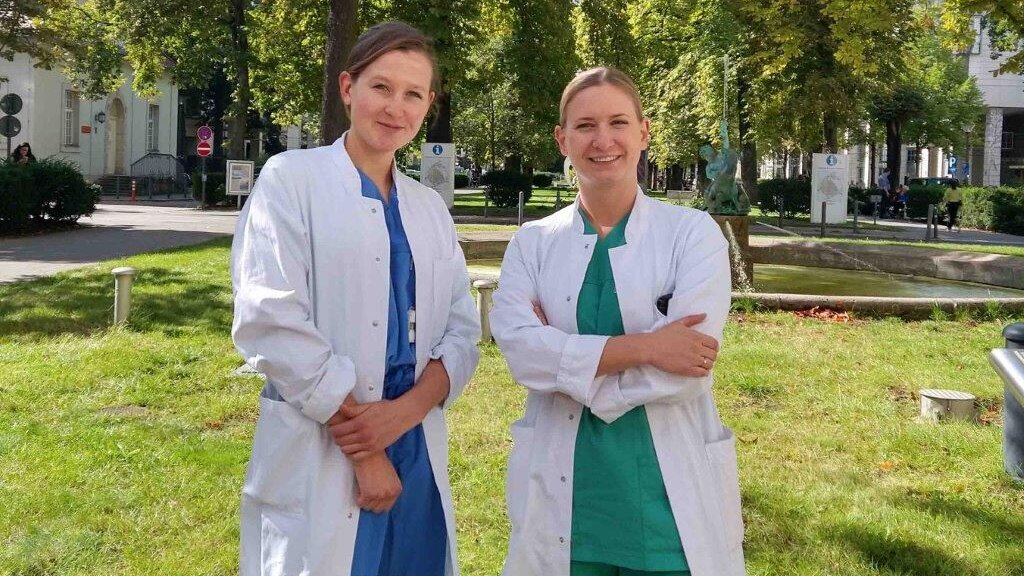
Assistant doctor Anna Stegmann (left) and cardiac surgeon Dr Pia Lanmüller work closely together in the DHZC mentoring programme.
#Magneterleben - Mentoring programme at the DHZC
Support, develop, exchange
Today we are introducing cardiac surgeon Dr Pia Lanmüller and junior doctor Anna Stegmann, who have been working together as a "mentoring pair" since this summer. Our picture shows them at one of their first meetings in the middle of the year.
After completing her medical studies in Marburg, Anna Stegmann came to Charité in 2021 as a junior doctor for further training in cardiac surgery. In August 2023, she applied for the mentoring programme at Charité's German Heart Centre; in addition to the exchange of experience and knowledge, the focus on scientific work was important to her.
In Pia Lanmüller, who completed her specialist training in cardiac surgery at the DHZC this year, she has found a mentor who shares her enthusiasm for the speciality.
They are now working together on a research project on gender-specific differences in patients with mechanical circulatory support and have already submitted a publication on a DHZC patient for scientific review.
For Anna Stegmann, the first step for this case presentation was intensive research in this area - with valuable support, as she finds: "Having a reference person for scientific work gives me a lot of stability, motivates me and makes it easier to make decisions."
Pia Lanmüller also draws a very positive interim conclusion: "It's fun to pass on knowledge, to achieve something together and to develop personally through the role of mentor."
In order to achieve good results, especially in scientific collaboration, the two agreed to work together for at least two years at the start of the peer coaching programme. Over the course of this time, the two will exchange information regularly by email and meet every two months for a detailed personal discussion.
Both are certain that they can continue to tackle many challenges together: In addition to continuing their joint research work, Anna Stegmann already has her sights firmly set on her next goals - completing her doctorate and completing her intensive rotation.
We would like to thank them both for the insight into the mentoring programme at the DHZC and of course wish them every success in achieving their goals!
What has happened so far - the long but rewarding road to the magnet clinic
July 2020: The journey begins
"Magnet4Europe" is an international intervention study on the reorganisation and design of the working environment in hospitals, based on the "Magnet Principles" developed in the USA. The former DHZB, now DHZC, was selected to participate in July 2020. A total of 60 clinics from six European countries are taking part in the study. Magnet4Europe is being led by five renowned international universities, with TU Berlin being responsible for Germany.
80s: The origin of the concept
The concept of "magnet clinics" was developed in the USA in the 1980s. At that time, the US hospital landscape was characterised by a shortage of nursing staff, inadequate care structures and dissatisfied employees, similar to the situation in Germany today.
However, some hospitals had both outstanding patient care and sufficient nursing staff, with low cancellation rates and high staff satisfaction.
A study by the ANA (Academy of Nursing, America) analysed the strengths of these clinics. Five key principles were identified that make a hospital a first-class healthcare provider and employer - and therefore "magnetic": Consistent measurement of empirical outcomes, transformational leadership, exemplary professional practice, structural empowerment, and innovation, new knowledge and research.
Subsequently, a concept for the application of these principles and an accreditation process were developed by the American Nurses Credentialing Centre (ANCC) as a certification body for nursing.
1994: The first certified clinic in the USA
In 1994, the first clinic in the USA was certified according to this procedure. There are now more than 540 clinics worldwide with Magnet status, mainly in the USA and Australia. In Europe, only two clinics have been recognised as Magnet clinics to date.
The Magnet principles focus on the quality of care, i.e. the outcome of patients and the culture of the clinic - achieved through respectful interprofessional collaboration, flat hierarchies and a focus on the health, personal development and education of all employees.
Numerous US studies in recent years have shown that cooperation between doctors and nurses in magnet hospitals is perceived as significantly better than in non-magnet hospitals. In addition, up to five per cent lower 30-day mortality rates were found in magnet clinics compared to non-magnet clinics.
The effects have also been documented among employees. For example, the burn-out rate is 7% lower and the willingness to change jobs is up to 40% lower than in non-magnet clinics.
The DHZC is also to become magnetic: By participating in Magnet4Europe, we can make this vision a reality with experienced partners.
Our "twin" since October 2020
The study is based on the principle that an already Magnet-certified US hospital closely accompanies a European "twin" on its own path to Magnet designation.
Since October 2020, our "twin hospital" has been Northwestern Medicine Delnor Hospital in Geneva, Illinois (near Chicago). Not only has the hospital been Magnet-certified for over 20 years, but it was also merged during the application process and has been helping us to successfully implement Magnet on the way to DHZC ever since.
In October 2020, we started with the first so-called "GAP analysis" to assess the current status on the way to becoming a Magnet hospital.
We completed this analysis as one of the 5 best of the 60 participating clinics. We were the only hospital to be invited to report on our first "magnet experiences" at an international event with around 500 hospitals.
The GAP analysis made us realise once again the goal of the entire initiative: Excellent patient care through close co-operation between the medical professions, innovative ideas, safe working conditions and good staffing levels. We are now setting out the necessary steps in a three-year plan. These include, for example, the development of a training concept for carers, risk-adjusted personnel planning, the implementation of joint, multi-professional and cross-hierarchical decision-making, the establishment of a quality dashboard and the creation of corresponding project teams.
The next step is to make Magnet tangible (not only) for all carers, to establish the underlying culture and to recognise the benefits of the system. An exciting journey continues!